
Baluster Spacing for Stairways and Balconies
Baluster Spacing for Staircases and Balconies
Building Codes
Determine Local Building Code Requirements
Correct baluster spacing on stairways and balconies is important for both creating a beautiful staircase and providing a safe staircase that complies with current building codes. The first step in determining your baluster spacing is to find out what the building code requires in your area. Before installing any railing system, homeowners, installers and/or architects should contact their local building inspection department to determine what is required. This will let you know how close the balusters need to be to each other.
The International Residence Code (IRC) 2009 R312.3 states the following: Required guards (railings) shall not have openings from the walking surface to the required guard height which allow passage of a sphere 4 inches in diameter. (Note: this is often referred to as the 4 inch rule). What it means in plain english is that the balusters have to be close enough to each other to prevent a 4" ball from being passed through the railing.
There are two exceptions to this, one of which states that guards on the open side of a stair (on the rake) shall not have openings which allow the passage of a sphere 4-3/8 inches in diameter. This allows for a little more space on the stairs; however, you should still check with your local building inspection department to determine what their exact requirements are.
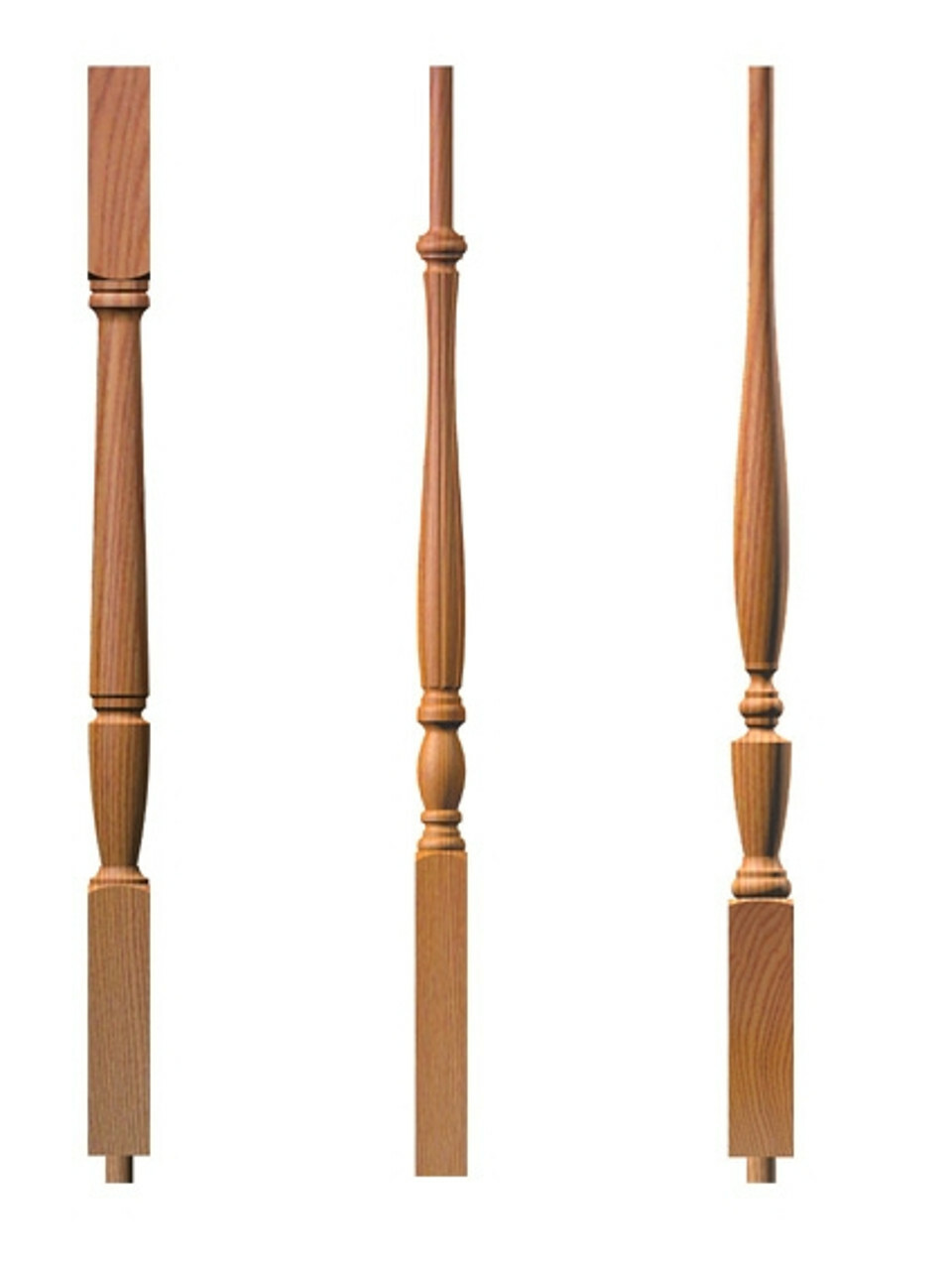
Shop for Wood Balusters
Wood Baluster Spacing
Wood Baluster Spacing on New Staircases
The following are spacing instructions for Traditional Center Line Baluster Placement. (Warning: the traditional center line baluster placment will require newel posts to be notched. If it is desired that newel posts not be notched, the balusters will have to be moved further from the outside edges of treads, landings and balconies in order to accomodate the placment of newels on said surfaces. Additionally, there may be design constraints that dictate the alternative placement of center lines. These include having the rail hit the center of a wall on partial open stairs, or achieving 1-1/2" handrail clearance at second floor stairwell openings. Another situation that sometimes dictates alternative center line placment is moving the balcony center line in to have the handrail, terminate solidly into a rosette, half newel or wall.)
On the rake, or angled portion of the stair, the two adjacent faces of the square portion of the baluster should align with the face of the skirtboard (or decorative tread bracket) and the riser below. For a 1-1/4" square baluster, the center point of the baluster location is the intersection that is 5/8" in from the outside face of the skirtboard and riser. (Note: The centerpoint for a 1-3/4" square balusters will be 7/8" in from the skirtboard and riser and on a 2-1/4" square baluster it is 1-1/4").
Once the placement of the first baluster on the stairs is located, the stair installer can determine the location of the other balusters quite easily. Just divide the unit tread run by the number of balusters to be used per tread for center-to-center spacing. (Warning: if measuring the tread run from the front edge of bullnose step, do not include the overhang of the next step up. You will end up with a run measurement that is too long.) (Example: For a system using two balusters per tread, divide the run of the tread by 2; i.e., 10" Run divided by 2 = 5" center-to-center. For a system using three balusters per tread, divide the run of the tread by 3; i.e., 10.5" divided by 3 = 3-1/2" center-to-center).
On the balcony, or level portion of a stair including landings, the traditional placement is one that aligns the front face of the baluster to the outside face of the finish material below (i.e. headboard or bandboard). Please see warning above concerning the notching of newel posts. If it is desired that the newel posts not be notched, please use alternative center-line placement of balusters.
For balconies and knee walls, measure the opening between the bottom square block of the newel and either the opposing newel or wall. Add the thickness of the baluster to this measurement. Example: if the opening between two newel posts is 71" and the balusters are 1-1/4" square, then add 71" + 1-1/4" = 72-1/4". Depending on code requirements, divide the total adjusted run length by the required spacing. Note: with a 4" sphere rule, the center-to-center spacing used most commonly is 4-1/2" center-to-center. Example: 72-1/4" divided by 4-1/2" = 16.05. Round up to 17 and divide back into the the overall run. 72-1/4" divided by 17 = 4-1/4". This balcony rail segment will contain 17 equal spaces and 16 balusters. Take the center-to-center spacing measurement and subtract 1/2 of the baluster square dimension. Example: 4-1/4" - 1/2(4-1/4) = 3-5/8". This measurement is used to mark the placement of the end balusters (next to the a newel or wall) on either side of the balcony segment. Warning: On some product combinations used the 4" sphere rule in effect, this form of layout can result in a non-code compliant measurement in the turned areas of the newels and balusters. Check the spacing measurement and re-calculate if necessary by adjusting the end balusters closer to the newels and/or wall and then remeasure the layout of the remaining balusters.
Wood Baluster Spacing - Remodeling Staircases
If you are re-modeling your staircase and wanting to simply replace the old wood balusters with new ones, you may be able to simply remove the old ones by cutting them out and pulling out the old ones and slipping the new balusters in place. The trick is to do this without damaging the existing wood handrail. There are times, when it will actually save time to just replace the handrail and the balusters. If you are using new wood balusters that will be stained, it will be much easier to replace the newel posts, handrail and wood balusters and finish them so that you have an exact match. Trying to match up to an old existing finish can be frustrating. If the new wood balusters are pin top balusters, you might need to detach the handrail and lift it up so that it will set down on the balusters.
Shop for Wood Balusters
Metal Baluster Spacing
Metal Baluster Spacing on New Staircases
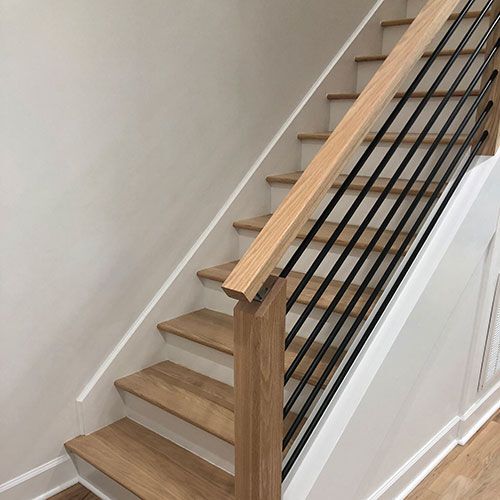
The spacing requirements for metal balusters on new staircases is the same as spacing for wood balusters. Many installers simply place the metal balusters 4 inches on center and don't try and "push it" by accounting for the thickness of the baluster. Most people use a pattern of different styles of complimentary iron baluster profiles to make up their pattern. There are some things to watch out for; however, when calculating spacing for metal balusters.
It is normally not possible to place two scroll balusters side by side. Most installation will require some type of straight plain type baluster to go in between the more ornate scroll balusters. Consider using straight, twist, knuckle or straight hammered balusters to match the style of scroll baluster that you plan on using. Use caution when planning the spacing of any scroll balusters on the stairs. Many scroll balusters cannot be placed in the back position on a tread, due to the scroll hitting the lip of the next tread up. Lay-out the pattern to prevent this from happening. On stairs with pony wall or knee walls, be aware that some iron spindles will not fit in between the wall cap and the bottom of the handrail. Keep in mind that in between newel posts and/or walls, the balusters may start and stop with different style balusters, which is O.K. You may want to start your pattern such that any larger more ornate scroll elements end up located in the section where you want them.
Metal Baluster Spacing on Existing Staircase
On existing staircases with wood balusters, you need to cut the wood balusters in the middle and pull out the top and bottom of the balusters from the handrail and treads, landings and/or balconies. You can cut the metal balusters longer than the length of the opening between the tread and bottom of the handrail and epoxy them in by slipping them up into the handrail at an angle and then seating the bottom into the hold. Use cap shoes for covering up the gaps where the square baluster goes into the round holes on the treads, balconies and underneath the handrail. There are pitch shoes available which can be used on pony walls and underneath the handrail on a rake. Homeowners should check local building code requirements to see if there is a requirement that they change the spacing from their existing baluster layout. Note that changing from wood balusters that are 1-1/4" or 1-3/4" square to a 1/2" or 9/16" square metal baluster will open up the space between the individual balusters. If you need to re-drill the spacing for the metal balusters and you want to keep the existing handrail, treads and landing tread, then you may need to plug the existing holes with tapered face plugs, sand them flush and re-drill the holes in the proper location.
Shop for Iron Balusters
Secure Shopping:
We offer online secure shopping
Payment Options:
Order Online 24 Hours a Day, 7 Days a Week, 365 Days a Year

Shipping Options:
We offer online shipping tracking

Stair Parts Iron Balusters Wood Balusters Box Newels Newel Posts Stair Handrails Handrail Fittings Stair Treads and Trim Stair Hardware Stainless Steel Stair Parts Circular & Spiral Stairs
Stair Handrails - Stair Treads - Stair Balusters at Discount Prices. Copyright 2007-2008 Stair Warehouse Site Design by SEOwhat

